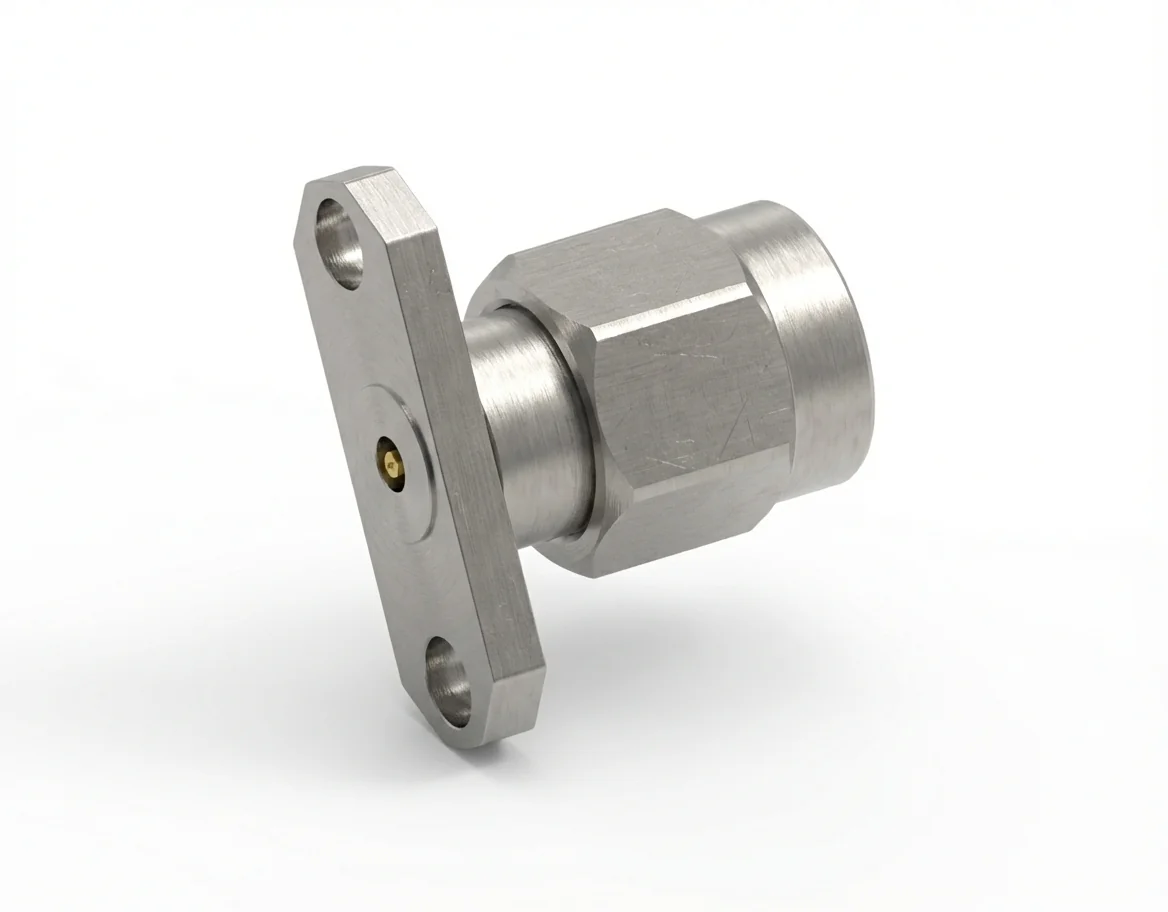
3.5mm Male 2-Hole Flange Mount RF Connector – Field Replaceable, 12.22mm Hole Spacing, 0.23mm Pin Diameter
3.5mm Male 2-Hole Flange Mount Field-Replaceable RF Connector – Model 3.5-JFD19
The 3.5 mm male 2-hole flange mount RF connector with a 0.23 mm pin and 12.22 mm hole spacing provides excellent stability for compact, high-frequency RF instruments and test modules. The field-replaceable configuration supports efficient connector serviceability with consistent electrical integrity.
Electrical Parameters and Signal Reliability
Featuring 50 Ω impedance, VSWR ≤ 1.1, and insertion loss ≤ 0.06 √F(GHz) dB, the 3.5-JFD19 connector achieves low insertion loss and high return-loss performance up to 26.5 GHz. Perfect for laboratory analyzers and broadband calibration systems. See more options in the 3.5 mm connector range.
Material Specifications and Certification
Constructed from corrosion-resistant stainless steel with gold-plated beryllium copper contacts, this connector delivers durability and strong signal continuity. It is fully REACH and RoHS compliant. Additional models are available in the flange-mount connector section.
Mechanical Layout and Panel Application
The 2-hole flange mount arrangement (12.22 mm spacing) offers strong attachment and precise positioning for instrument panels and modular assemblies. Its compact design supports dense installation layouts. Explore the RF connector catalog for similar field-replaceable interfaces.